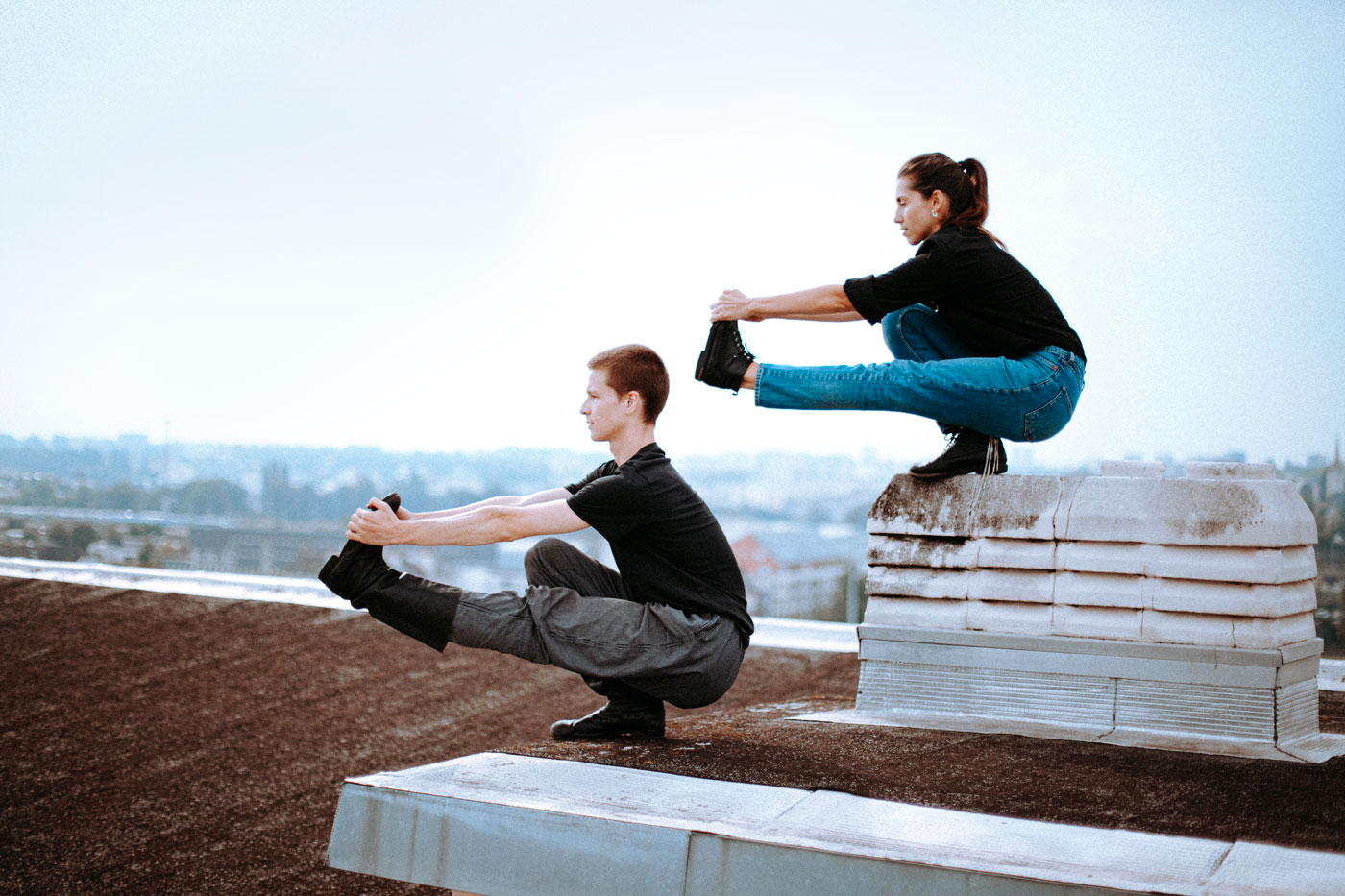
Hopak
Since 2022, the Russian invasion of Ukraine has been accompanied by a cultural conflict whose aim is to eradicate all Ukrainian identity. Russia's official discourse insists that properly Ukrainian culture does not exist.
The Hopak project is based on research into traditional Ukrainian dances. Distinguishing Ukrainian dances from Russian ones is not easy, due to centuries of forced cultural assimilation, territorial expansion, repression and linguistic oppression. What would these dances be like today if they had been able to develop freely ? What would they look like without having been stifled and dominated ?
Hopak is a play between historical heritage and a minimalist approach that tends to reduce each dance to its starting point. From there, it creates new ones. And it's possible that these waves, these constant back-and-forth movements between past and future, may free the path toward metaphors, imagination or unpredictable meanings.
Distribution / Team
- Choreography : Olga Dukhovna
- Performance : François Malbranque, Olga Dukhovna, Éric Allard-Jacquin
- Dramaturgy : Simon Hatab
- Sound : Dennis Weijers
- Lighting : Erik Houllier
- Costumes : Soraya MoBé
- Stage Management : Denis Malard
- Production : Amélie-Anne Chapelain and Enora Floc’h / C.A.M.P
- Special thanks to Alexis Hedouin, François Maurisse, Julien Monty
Premiere
- 2024, May 25 — Théâtre Louis Aragon, Tremblay-en-France, France
Partners
- C.A.M.P Production
- Co-production : Théâtre Louis Aragon – Scène conventionnée d’intérêt national Art & création de Tremblay-en-France, Mille Plateaux - CCN La Rochelle, Le Triangle – Cité de la Danse à Rennes, Chorège – CDCN Falaise Normandie, Les Rencontres Internationales de Seine St-Denis, LA MAISON CDCN Uzès, Le Petit Écho de la Mode. With the support of Caisse des Dépôts. Thanks to CCNRB – Collectif FAIR-E for the use of their studio space.
- C.A.M.P is a cultural and artistic organization of general interest based in the Lorient region. It is supported by the DRAC Bretagne, the Brittany Region, the Morbihan Department, Lorient Agglomeration, and the cities of Lorient and Plouhinec. It also receives support from the Caisse des Dépôts and the Marie-Thérèse Allier Fund.